ReFinE: Bringing HCI Research into the Figma Design Workflow
A summary of an HCI paper exploring how AI can bring research insights into the design workflow.
Tutoriales

Based on: ReFinE: Streamlining UI Mockup Iteration with Research Findings. Shin, D., Guo, B., Lee, J., Wang, L. L., & Hsieh, G. DIS 2026 — Proceedings of the 2026 ACM Designing Interactive Systems Conference DOI: 10.1145/3800645.3812860
HCI research contains a huge amount of valuable knowledge for designers: usability findings, design guidelines, and evidence that can help inform design decisions. However, putting that research into practice is often easier said than done.
Designers have to find relevant papers, deal with technical and academic language, understand whether the findings actually apply to their project, and finally translate them into concrete design decisions. This becomes particularly difficult during prototyping, when designers are iterating quickly and working under time constraints.
ReFinE addresses this gap by bringing research directly into the design workflow through an AI-powered Figma plugin.

Connecting research and design
ReFinE explores a different approach: bringing HCI research directly into the designer’s workspace.
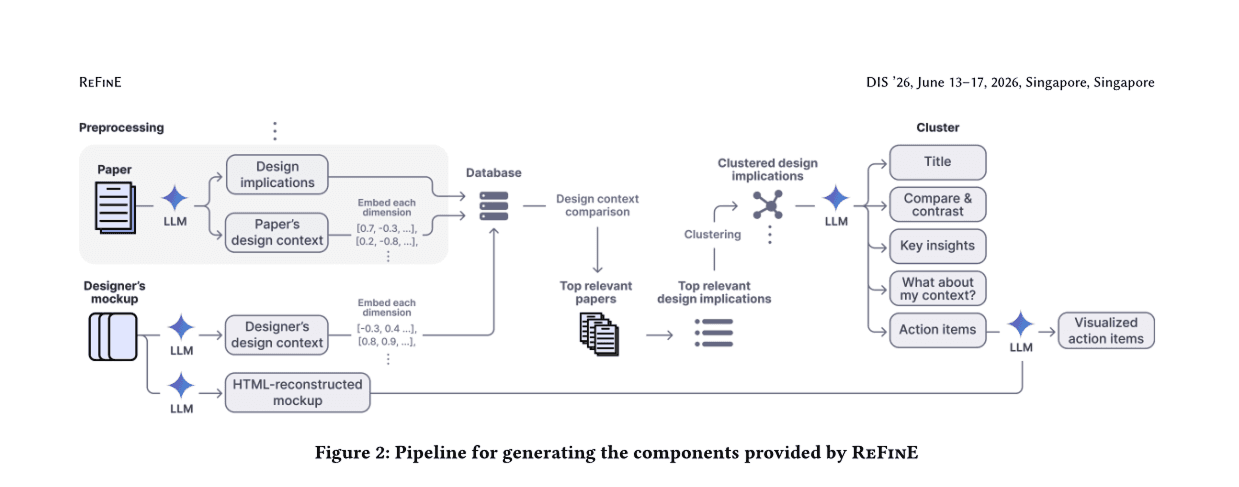
The system analyzes a designer’s mockup, identifies its context, retrieves relevant HCI research, extracts and groups design implications, and translates them into recommendations tailored to the specific design.
Most importantly, it visualizes how those recommendations could be applied to the interface.
Instead of simply providing a list of papers or summaries, ReFinE attempts to transform academic research into something designers can understand, evaluate, and potentially apply while working on their designs.
From reading research to seeing its impact
One of the most interesting findings is the role of visualization.
Participants found it easier to understand and evaluate research-backed recommendations when they could see the proposed changes applied to their design rather than having to interpret large amounts of text.
This made the insights faster to understand, easier to validate, and more actionable.
The study also reinforces something important: AI does not necessarily replace the designer’s expertise.
Participants still used their own judgment to accept, modify, or reject the suggestions. The technology acted as an additional source of evidence and inspiration within their workflow.
What the results tell us
The researchers conducted a user study with 12 designers and UX/UI students. Compared with the traditional process of manually searching for and interpreting research, participants using ReFinE:
Reached their first design iteration in around 5 minutes, compared with 13 minutes without ReFinE.
Made an average of 5.5 design edits, compared with 2.4.
Experienced significantly lower mental, temporal, and physical workload.
Considered the resulting insights more relevant, valid, inspirational, generative, and actionable.
Found the visual action items useful for understanding and applying research findings.
The study also showed that designers appreciated discovering relevant research beyond the exact keywords they would normally search for.
But perhaps the most interesting result is not any individual metric. It is the possibility of changing how designers interact with knowledge.
Instead of research being something we consult separately from the design process, technologies like ReFinE can bring knowledge closer to the moment when a design decision is being made.
Beyond the prototype
The research also highlights some limitations and interesting directions for future work.
For example, the current system tends to suggest adding UI elements rather than simplifying or removing them. This raises an important question about AI-assisted design: should AI primarily help us add things, or should it also help us identify what can be removed?
The researchers also suggest expanding the system beyond the CHI 2024 papers used in the study, incorporating research from other HCI conferences and disciplines such as psychology or communication.
Another interesting direction is giving designers more control over the context used by the system. A mockup cannot communicate everything a designer knows about a project. Goals, constraints, stakeholder requirements, and strategic decisions often exist outside the canvas.

Bridging research and design practice
What I find most interesting about ReFinE is not simply the use of AI to summarize research. The more important idea is the integration of evidence-informed design into the designer’s existing workflow.
Instead of asking designers to leave Figma, search through academic databases, read papers, interpret findings, and then return to their designs, ReFinE attempts to bring that knowledge into the place where design decisions are actually being made.
It proposes a bridge between two worlds that often remain disconnected: academic HCI research and everyday design practice.
Design is constantly evolving
This is what I take away from ReFinE.
UX/UI is not a static discipline. The tools, technologies, methodologies, and possibilities available to designers are constantly changing.
AI is only the latest example, but the underlying principle is broader: designers need to continuously explore new technologies and understand how they can improve the way we work.
That does not mean adopting every new tool simply because it is new. It means experimenting, questioning its value, understanding its limitations, and incorporating it when it genuinely improves the design process.


The role of the designer is therefore evolving as well. Our value is not only in knowing how to use a particular tool, but in knowing how to combine technology, research, critical thinking, and design expertise to make better decisions.
ReFinE is an interesting example of what this future could look like: research, AI, and design working together inside the same workflow.
The full paper goes much deeper into the technology behind ReFinE, including its retrieval system, LLM pipeline, visual reconstruction process, technical evaluation, and user study.
Más por descubrir


ReFinE: Bringing HCI Research into the Figma Design Workflow
A summary of an HCI paper exploring how AI can bring research insights into the design workflow.
Tutoriales
Based on: ReFinE: Streamlining UI Mockup Iteration with Research Findings. Shin, D., Guo, B., Lee, J., Wang, L. L., & Hsieh, G. DIS 2026 — Proceedings of the 2026 ACM Designing Interactive Systems Conference DOI: 10.1145/3800645.3812860
HCI research contains a huge amount of valuable knowledge for designers: usability findings, design guidelines, and evidence that can help inform design decisions. However, putting that research into practice is often easier said than done.
Designers have to find relevant papers, deal with technical and academic language, understand whether the findings actually apply to their project, and finally translate them into concrete design decisions. This becomes particularly difficult during prototyping, when designers are iterating quickly and working under time constraints.
ReFinE addresses this gap by bringing research directly into the design workflow through an AI-powered Figma plugin.
Connecting research and design
ReFinE explores a different approach: bringing HCI research directly into the designer’s workspace.
The system analyzes a designer’s mockup, identifies its context, retrieves relevant HCI research, extracts and groups design implications, and translates them into recommendations tailored to the specific design.
Most importantly, it visualizes how those recommendations could be applied to the interface.
Instead of simply providing a list of papers or summaries, ReFinE attempts to transform academic research into something designers can understand, evaluate, and potentially apply while working on their designs.
From reading research to seeing its impact
One of the most interesting findings is the role of visualization.
Participants found it easier to understand and evaluate research-backed recommendations when they could see the proposed changes applied to their design rather than having to interpret large amounts of text.
This made the insights faster to understand, easier to validate, and more actionable.
The study also reinforces something important: AI does not necessarily replace the designer’s expertise.
Participants still used their own judgment to accept, modify, or reject the suggestions. The technology acted as an additional source of evidence and inspiration within their workflow.
What the results tell us
The researchers conducted a user study with 12 designers and UX/UI students. Compared with the traditional process of manually searching for and interpreting research, participants using ReFinE:
Reached their first design iteration in around 5 minutes, compared with 13 minutes without ReFinE.
Made an average of 5.5 design edits, compared with 2.4.
Experienced significantly lower mental, temporal, and physical workload.
Considered the resulting insights more relevant, valid, inspirational, generative, and actionable.
Found the visual action items useful for understanding and applying research findings.
The study also showed that designers appreciated discovering relevant research beyond the exact keywords they would normally search for.
But perhaps the most interesting result is not any individual metric. It is the possibility of changing how designers interact with knowledge.
Instead of research being something we consult separately from the design process, technologies like ReFinE can bring knowledge closer to the moment when a design decision is being made.
Beyond the prototype
The research also highlights some limitations and interesting directions for future work.
For example, the current system tends to suggest adding UI elements rather than simplifying or removing them. This raises an important question about AI-assisted design: should AI primarily help us add things, or should it also help us identify what can be removed?
The researchers also suggest expanding the system beyond the CHI 2024 papers used in the study, incorporating research from other HCI conferences and disciplines such as psychology or communication.
Another interesting direction is giving designers more control over the context used by the system. A mockup cannot communicate everything a designer knows about a project. Goals, constraints, stakeholder requirements, and strategic decisions often exist outside the canvas.
Bridging research and design practice
What I find most interesting about ReFinE is not simply the use of AI to summarize research. The more important idea is the integration of evidence-informed design into the designer’s existing workflow.
Instead of asking designers to leave Figma, search through academic databases, read papers, interpret findings, and then return to their designs, ReFinE attempts to bring that knowledge into the place where design decisions are actually being made.
It proposes a bridge between two worlds that often remain disconnected: academic HCI research and everyday design practice.
Design is constantly evolving
This is what I take away from ReFinE.
UX/UI is not a static discipline. The tools, technologies, methodologies, and possibilities available to designers are constantly changing.
AI is only the latest example, but the underlying principle is broader: designers need to continuously explore new technologies and understand how they can improve the way we work.
That does not mean adopting every new tool simply because it is new. It means experimenting, questioning its value, understanding its limitations, and incorporating it when it genuinely improves the design process.
The role of the designer is therefore evolving as well. Our value is not only in knowing how to use a particular tool, but in knowing how to combine technology, research, critical thinking, and design expertise to make better decisions.
ReFinE is an interesting example of what this future could look like: research, AI, and design working together inside the same workflow.
The full paper goes much deeper into the technology behind ReFinE, including its retrieval system, LLM pipeline, visual reconstruction process, technical evaluation, and user study.
Más por descubrir
ReFinE: Bringing HCI Research into the Figma Design Workflow
A summary of an HCI paper exploring how AI can bring research insights into the design workflow.
Tutoriales
Based on: ReFinE: Streamlining UI Mockup Iteration with Research Findings. Shin, D., Guo, B., Lee, J., Wang, L. L., & Hsieh, G. DIS 2026 — Proceedings of the 2026 ACM Designing Interactive Systems Conference DOI: 10.1145/3800645.3812860
HCI research contains a huge amount of valuable knowledge for designers: usability findings, design guidelines, and evidence that can help inform design decisions. However, putting that research into practice is often easier said than done.
Designers have to find relevant papers, deal with technical and academic language, understand whether the findings actually apply to their project, and finally translate them into concrete design decisions. This becomes particularly difficult during prototyping, when designers are iterating quickly and working under time constraints.
ReFinE addresses this gap by bringing research directly into the design workflow through an AI-powered Figma plugin.
Connecting research and design
ReFinE explores a different approach: bringing HCI research directly into the designer’s workspace.
The system analyzes a designer’s mockup, identifies its context, retrieves relevant HCI research, extracts and groups design implications, and translates them into recommendations tailored to the specific design.
Most importantly, it visualizes how those recommendations could be applied to the interface.
Instead of simply providing a list of papers or summaries, ReFinE attempts to transform academic research into something designers can understand, evaluate, and potentially apply while working on their designs.
From reading research to seeing its impact
One of the most interesting findings is the role of visualization.
Participants found it easier to understand and evaluate research-backed recommendations when they could see the proposed changes applied to their design rather than having to interpret large amounts of text.
This made the insights faster to understand, easier to validate, and more actionable.
The study also reinforces something important: AI does not necessarily replace the designer’s expertise.
Participants still used their own judgment to accept, modify, or reject the suggestions. The technology acted as an additional source of evidence and inspiration within their workflow.
What the results tell us
The researchers conducted a user study with 12 designers and UX/UI students. Compared with the traditional process of manually searching for and interpreting research, participants using ReFinE:
Reached their first design iteration in around 5 minutes, compared with 13 minutes without ReFinE.
Made an average of 5.5 design edits, compared with 2.4.
Experienced significantly lower mental, temporal, and physical workload.
Considered the resulting insights more relevant, valid, inspirational, generative, and actionable.
Found the visual action items useful for understanding and applying research findings.
The study also showed that designers appreciated discovering relevant research beyond the exact keywords they would normally search for.
But perhaps the most interesting result is not any individual metric. It is the possibility of changing how designers interact with knowledge.
Instead of research being something we consult separately from the design process, technologies like ReFinE can bring knowledge closer to the moment when a design decision is being made.
Beyond the prototype
The research also highlights some limitations and interesting directions for future work.
For example, the current system tends to suggest adding UI elements rather than simplifying or removing them. This raises an important question about AI-assisted design: should AI primarily help us add things, or should it also help us identify what can be removed?
The researchers also suggest expanding the system beyond the CHI 2024 papers used in the study, incorporating research from other HCI conferences and disciplines such as psychology or communication.
Another interesting direction is giving designers more control over the context used by the system. A mockup cannot communicate everything a designer knows about a project. Goals, constraints, stakeholder requirements, and strategic decisions often exist outside the canvas.
Bridging research and design practice
What I find most interesting about ReFinE is not simply the use of AI to summarize research. The more important idea is the integration of evidence-informed design into the designer’s existing workflow.
Instead of asking designers to leave Figma, search through academic databases, read papers, interpret findings, and then return to their designs, ReFinE attempts to bring that knowledge into the place where design decisions are actually being made.
It proposes a bridge between two worlds that often remain disconnected: academic HCI research and everyday design practice.
Design is constantly evolving
This is what I take away from ReFinE.
UX/UI is not a static discipline. The tools, technologies, methodologies, and possibilities available to designers are constantly changing.
AI is only the latest example, but the underlying principle is broader: designers need to continuously explore new technologies and understand how they can improve the way we work.
That does not mean adopting every new tool simply because it is new. It means experimenting, questioning its value, understanding its limitations, and incorporating it when it genuinely improves the design process.
The role of the designer is therefore evolving as well. Our value is not only in knowing how to use a particular tool, but in knowing how to combine technology, research, critical thinking, and design expertise to make better decisions.
ReFinE is an interesting example of what this future could look like: research, AI, and design working together inside the same workflow.
The full paper goes much deeper into the technology behind ReFinE, including its retrieval system, LLM pipeline, visual reconstruction process, technical evaluation, and user study.